Three product lines,
one complete chain.
Execution, orchestration and application each do their job, sharing one data and process model. Use any one alone, or chain them together.
RPA automation
A great deal of work in any company needs no judgement at all — just someone following steps: log in, export a sheet, fill a form, switch to the next system and type it again. It burns people's time, and the longer it goes on the more mistakes creep in.
Daedalus's RPA runs on an engine we built ourselves — the same one behind our workflow product. It isn't a third-party screen recorder bolted on; every automated run is orchestrated, logged and replayable under one process model.
Live demo: issuing one invoice
Below are the full steps for issuing one VAT invoice. The whole run is unattended, and every step's duration and output is written to the execution log. A failure can be replayed from where it stopped.
Multiple legal entities
One process switches tax IDs and certificates per entity, issuing and archiving separately.
Replayable failures
An interruption leaves no dirty data. Resume from the failed step instead of rerunning everything.
ERP integration
Pulls documents and reports straight from the ERP — no manual export, cleanup and re-upload.
DingTalk integration
Results and tasks are pushed back to DingTalk, so approvals stay where the team already works.
// Steps and timings are illustrative. RPA is in private beta; we make no public performance claims yet.
Workflow
Cheng (澄, to clarify) — clean up messy ERP data. Guan (观, to observe) — see the state of the business, the risks and the next move in that data. It covers supply chain, finance, operations and HR, with rules modelled from human expertise rather than left to a model's own judgement.
Four layers, not a chat box
Most enterprise AI stops at question-and-answer. Chengguan builds intelligence on top of the data and process layers: first make the data correct, the process connected and the rules explicit — only then does an agent make judgements at the top. That is why every output the system produces has a traceable source.
Agent
Analyses, proposes and triggers processes, inside the limits set by rules and data.
Rule engine
Your business rules and compliance boundaries, defined explicitly and editable by people.
Process orchestration
Approval flows, data flows and task flows orchestrated and tracked together.
Data foundation
Connects directly to your data, cleans it, aligns it and builds the foundation everything else stands on.
Daedalus CRM
The most complete of the three product lines , and already open source. Leads, customers, contacts, follow-ups, deals and referral attribution in one place — the data your workflows produce lands here on specific people and specific deals, closing a loop you can follow. No forms, no sales call. Clone it and one command gets it running.
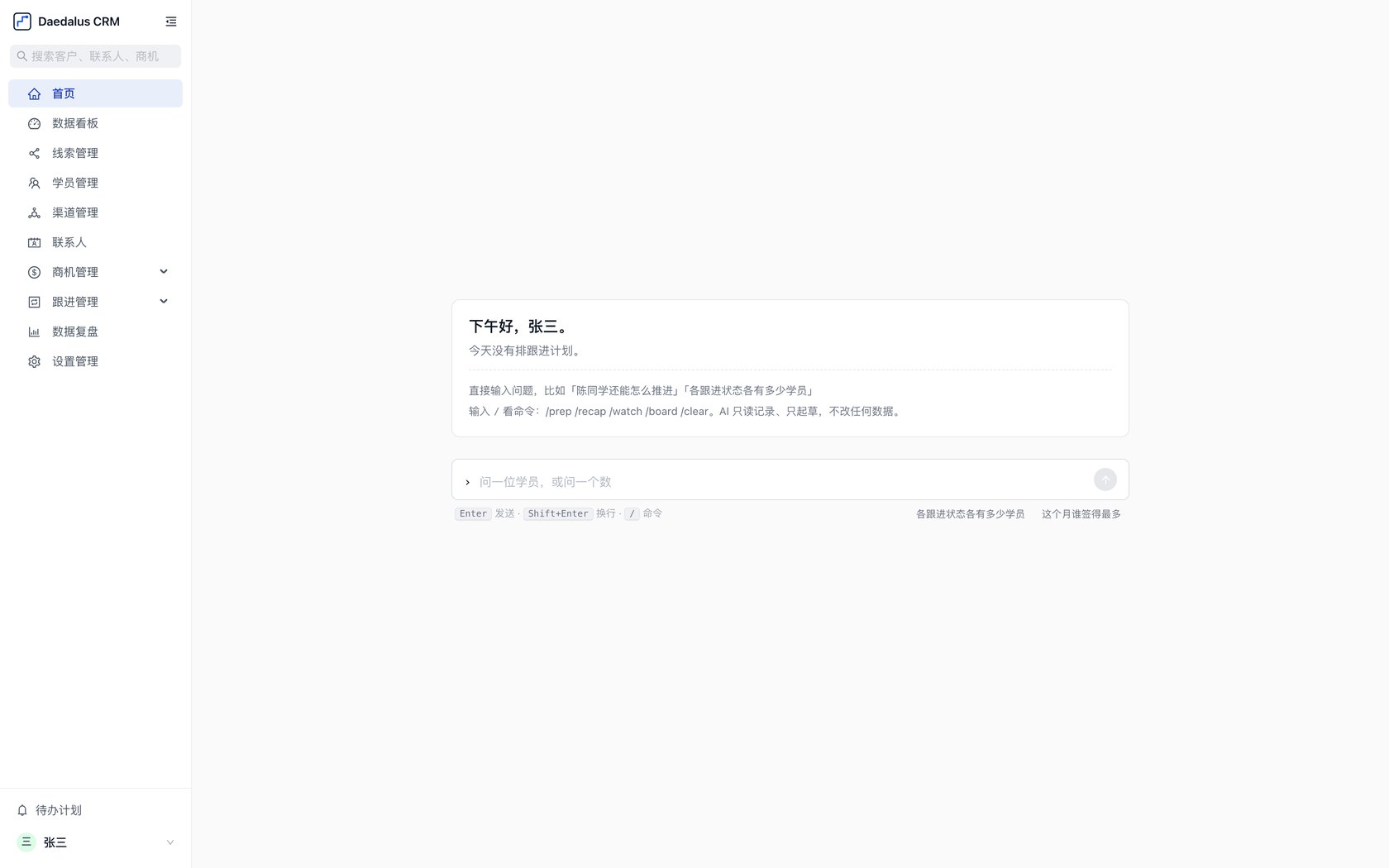
v0.6 replaced the home screen with an agent conversation, modelled on Claude Code and Codex: ask about a customer or ask for a number, and the model decides what to search, read and query — one visible line per call. Every tool is read-only; writes are always a human click.
git clone https://github.com/BeckY824/daedalus-crm.git && docker compose up -d
GitHub ↗
AGPL-3.0 · single SQLite file · amd64 / arm64
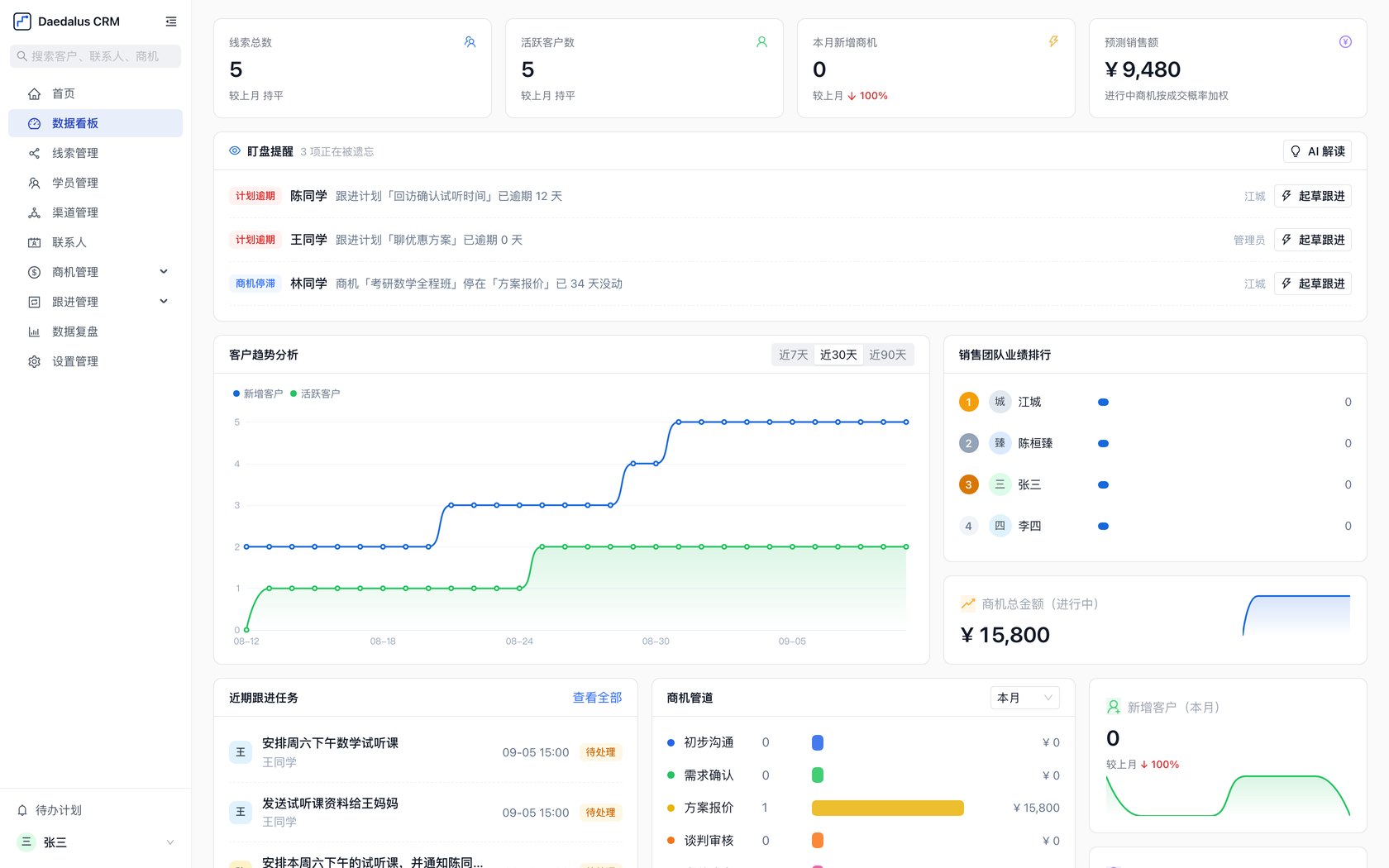
Dashboard
Total leads, active customers, new deals this month, forecast revenue; customer trends, team leaderboard and the deal funnel. The forecast weights deal value × win probability.
Leads and conversion
Capture leads, move them through statuses, convert in one click — the customer and contact are created and linked automatically.
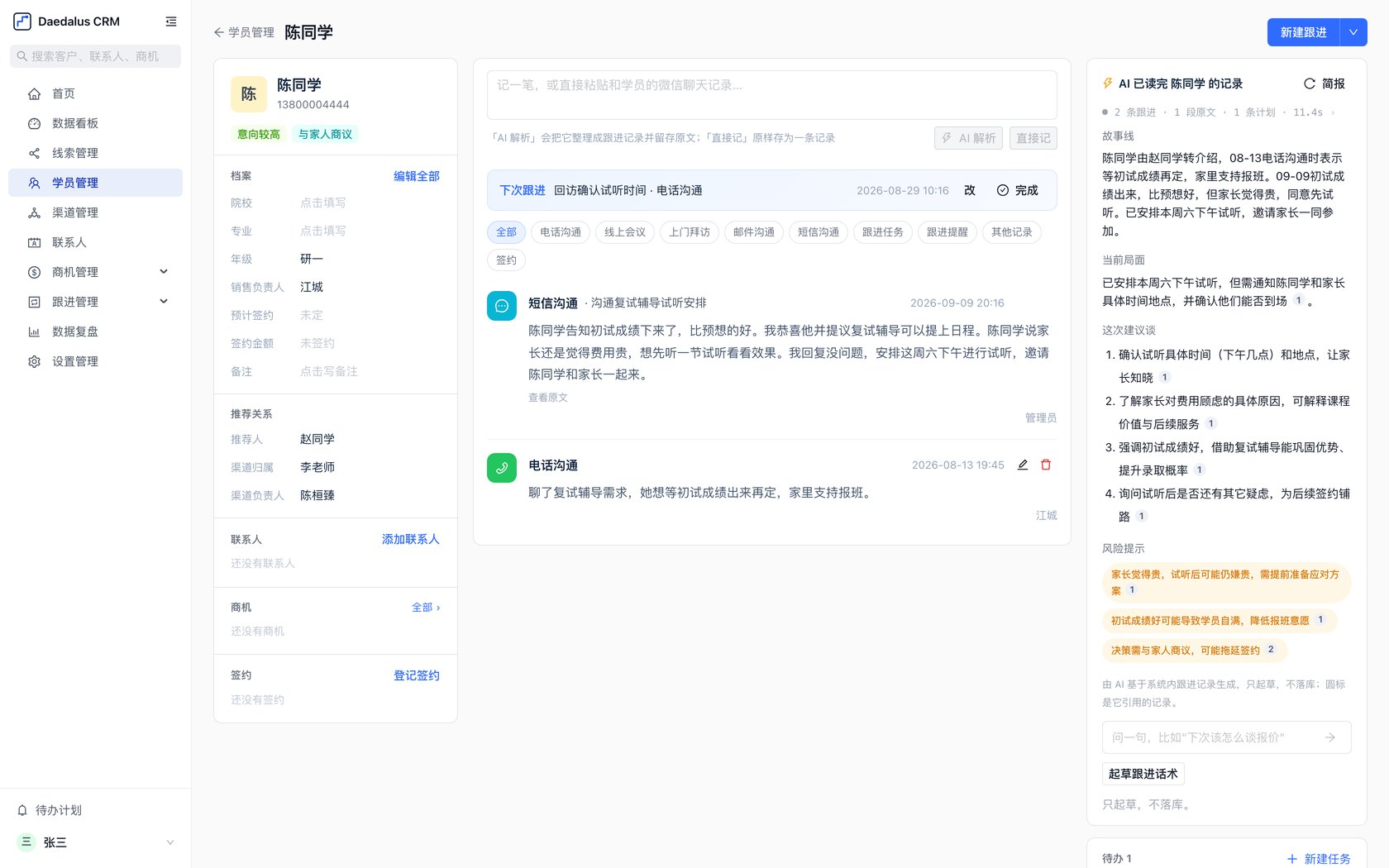
Record page, three panes
Click any field on the left to edit it; a single timeline in the middle (eight follow-up types); on the right a standing AI brief: the story so far, where things stand, what to raise next, and the risks.
Deal pipeline
Change stage inline in the list, or drag across the board. Win probability follows the stage automatically.
Referral attribution
Referrer, channel and channel owner are three independent roles. Attribution is fixed at entry, so changing someone upstream never retroactively rewrites existing results.
Concurrent editing
When two people edit at once, different fields merge automatically. Only a genuine clash is blocked — and it tells you exactly which fields collided.
Audit trail
Everyone can see and edit the data, but every write is logged — append-only, never edited, never deleted。
AI drafts, it never writes
Paste a WeChat conversation into the record page and AI turns it into a follow-up note, tasks and a next step. You review, then save; the original is kept. The AI panel on the right has already read whoever you just opened.
Bring any model
Enter an endpoint, key and model name in settings: DeepSeek, OpenAI, a local Ollama — any of them. Configure none and the AI entry points simply disappear.
From the product to your actual situation.
Walk us through your process. We'll tell you which one or two product lines fit, and which steps should not be handed to AI at all。